The Resurgence of American Custom Manufacturing and Engineering
American manufacturing is experiencing a genuine revival. After decades of offshoring, companies across the industrial sector are rediscovering the strategic advantages of keeping custom manufacturing and engineering close to home. Shorter lead times, tighter quality control, and the ability to collaborate face-to-face with the people actually making your parts are no longer “nice to haves.” They are competitive necessities.
The most significant shift is not just where parts are made, but how engineering design and production are converging under one roof to eliminate waste, speed up timelines, and produce better components. This convergence of custom manufacturing and engineering is reshaping how industrial buyers source everything from precision-machined sheaves to complex electro-mechanical assemblies. Quality is no longer a line item you negotiate separately. It is built into the process from the first conversation with an engineer to the final inspection before shipment.
If you are an OEM buyer, a maintenance engineer, or a procurement lead sourcing custom industrial components, the landscape has changed in your favor. U.S.-based manufacturers are investing in CNC capacity, expanding their engineering teams, and building stocking programs designed to give you the responsiveness that overseas suppliers simply cannot match. This article breaks down what that looks like in practice, what to ask potential partners, and why the resurgence of domestic custom manufacturing is more than a headline.
What Buyers Mean By Integrated Manufacturing
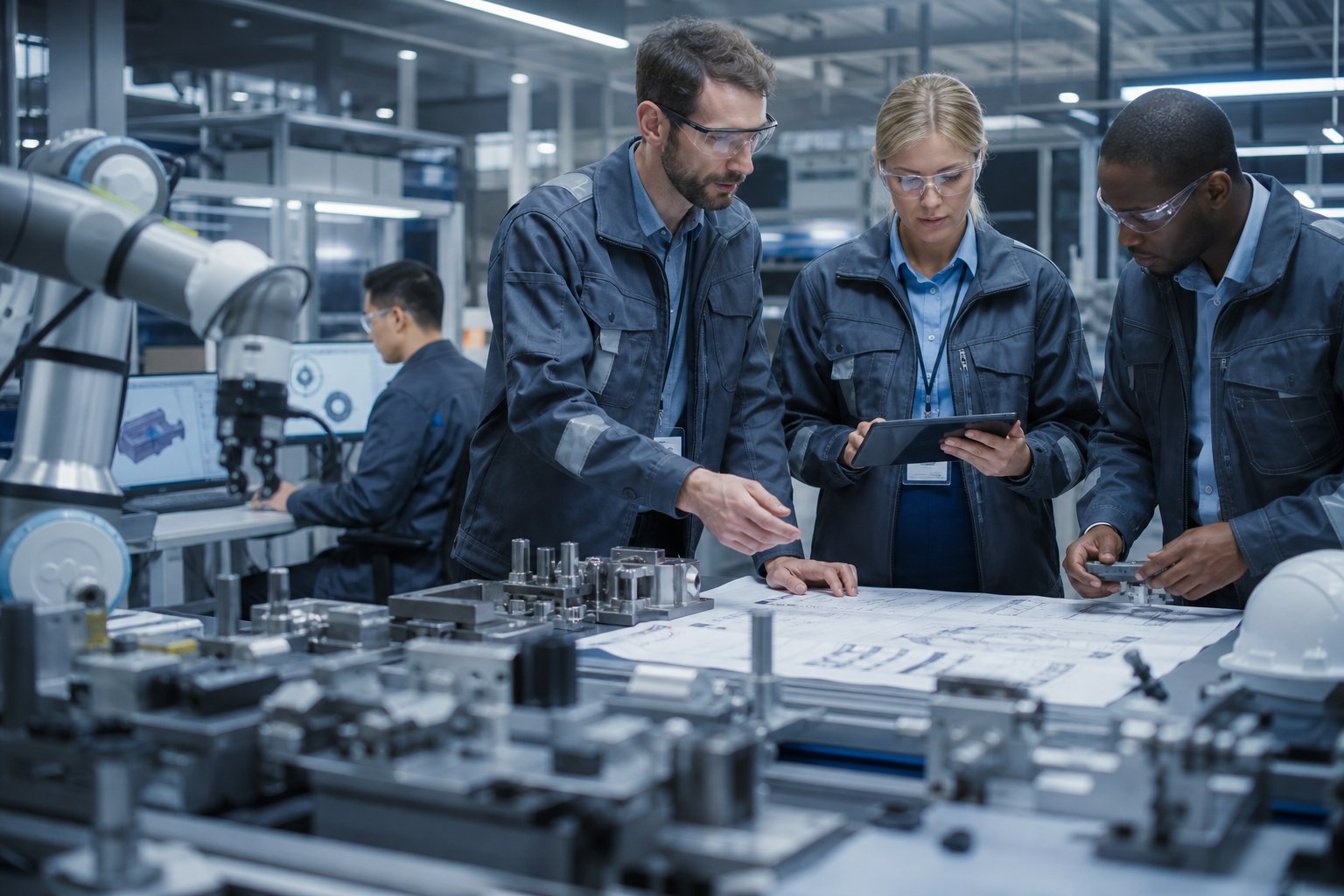
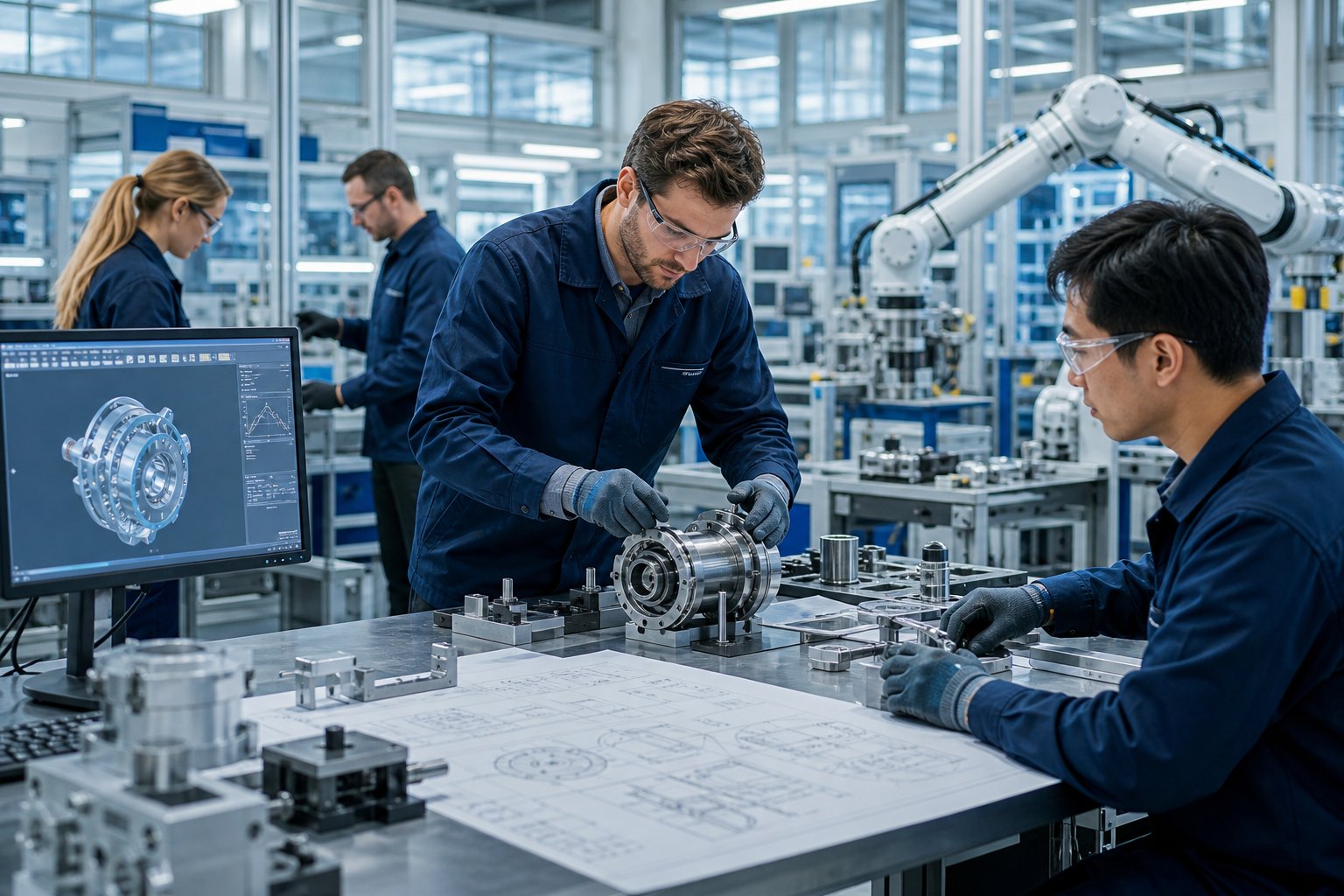
Integrated manufacturing means your engineering services and production happen in the same facility, managed by the same team. When engineering design, machining, fabrication, and assembly share a single workflow, communication gaps shrink and product development accelerates. The term CME, often used in industry shorthand, reflects this combination of custom manufacturing and engineering as a unified discipline rather than two separate vendor relationships.
Where Engineering Design Ends And Production Begins
In a traditional model, you hand a finished drawing to a contract manufacturing shop and wait. The problem is that drawings rarely capture every manufacturing nuance. Tolerances that look fine on screen may drive up machining time. Material selections might not account for post-machining processes like flame hardening or plating.
When engineering design and production exist in the same building, your design engineer can walk to the CNC operator’s station and resolve ambiguities in minutes. That handoff, the point where design ends and production begins, becomes a conversation instead of a bottleneck. As noted in a practical overview from Fathom Manufacturing, engineering a product so it can be mass-produced requires a different set of skills than building a one-off prototype.
How Contract Manufacturing Differs From Build-To-Print Work
Build-to-print means you provide a complete, finalized drawing and the manufacturer produces exactly what is specified. Contract manufacturing, by contrast, often includes engineering input, material recommendations, and design-for-manufacturability feedback.
If your drawings are production-ready and fully validated, build-to-print can work well. But if you are developing new components or adapting existing ones, a contract manufacturing partner that offers proactive DFM feedback will flag issues before they become expensive mistakes. The distinction matters because it determines whether your supplier is a passive executor or an active collaborator.
Why One-Roof Collaboration Reduces Rework
Rework is the silent killer of project timelines and budgets. It typically stems from miscommunication between separate engineering and manufacturing teams, each operating with slightly different assumptions.
When all manufacturing services live under one roof, the feedback loop tightens dramatically. An engineer reviewing your application can consult the machinist about achievable tolerances, check bore options with the assembly team, and confirm finishing compatibility, all before the first chip is cut. Bear Equipment, for example, integrates its engineering review, CNC machining, welding, and assembly in a single facility, which eliminates the coordination delays that plague multi-vendor projects. That kind of product development workflow turns rework from a recurring problem into a rare exception.
Why U.S.-Based Production Matters More Than Ever
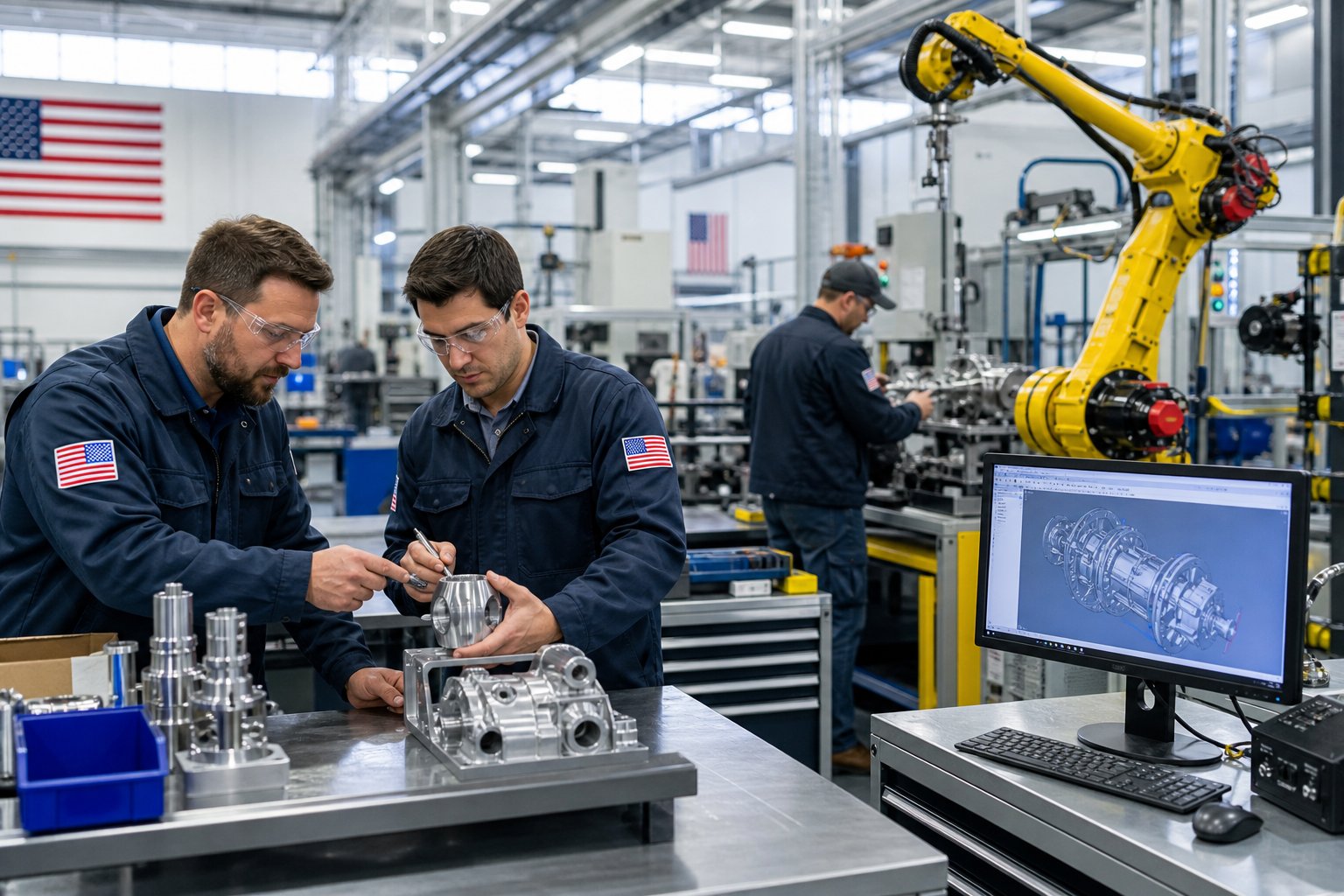
Domestic manufacturing is no longer just a patriotic talking point. It is a strategic decision driven by tariff uncertainty, supply chain fragility, and the growing demand for faster fulfillment. Lean manufacturing principles work best when you can control variables end to end, and that control is far easier to maintain when your supplier operates in the same country, the same time zone, and under the same regulatory framework.
Domestic Supply Chains And Delivery Confidence
Every week your component spends on a container ship is a week you cannot respond to demand changes. U.S. manufacturing provides shorter, more predictable lead times because raw materials, machining, and shipping all happen within a tighter geographic radius.
When you source domestically, you also reduce your exposure to port congestion, customs delays, and international freight cost spikes. For industrial components like wire rope sheaves, blocks, and winches, delivery confidence directly affects your project timelines and your ability to keep equipment operational.
Essential U.S. Manufacturer Value In Industrial Sourcing
Working with an essential U.S. manufacturer means you are partnering with a company whose operations, workforce, and supply chain are rooted in the American industrial base. That has tangible quality implications.
Domestic manufacturers are subject to consistent regulatory standards, use traceable materials, and maintain accountability that is difficult to enforce across international borders. As one analysis of reshoring trends notes, companies investing in U.S. production are aligning with both market trends and cultural expectations around transparency and reliability. The price gap between domestic and offshore production is also narrowing, making the fulfillment and quality advantages of U.S.-based sourcing more compelling than they have been in years.
Communication Speed, Accountability, And Change Control
You have probably experienced the frustration of sending a design revision to an overseas supplier at 4 PM and waiting twelve hours for a response. Multiply that by every question, every change order, every quality concern, and the time cost compounds quickly.
With a U.S.-based partner, you get same-day responses, real-time phone calls, and the ability to visit the shop floor when a critical project demands it. American manufacturers stand behind their products with direct accountability and provide the kind of customer support that builds long-term relationships. Change control, the process of managing design revisions during production, works far more smoothly when your engineering contact and your machinist share the same building and the same business hours.
Precision CNC Machining And Fabrication For Industrial Components
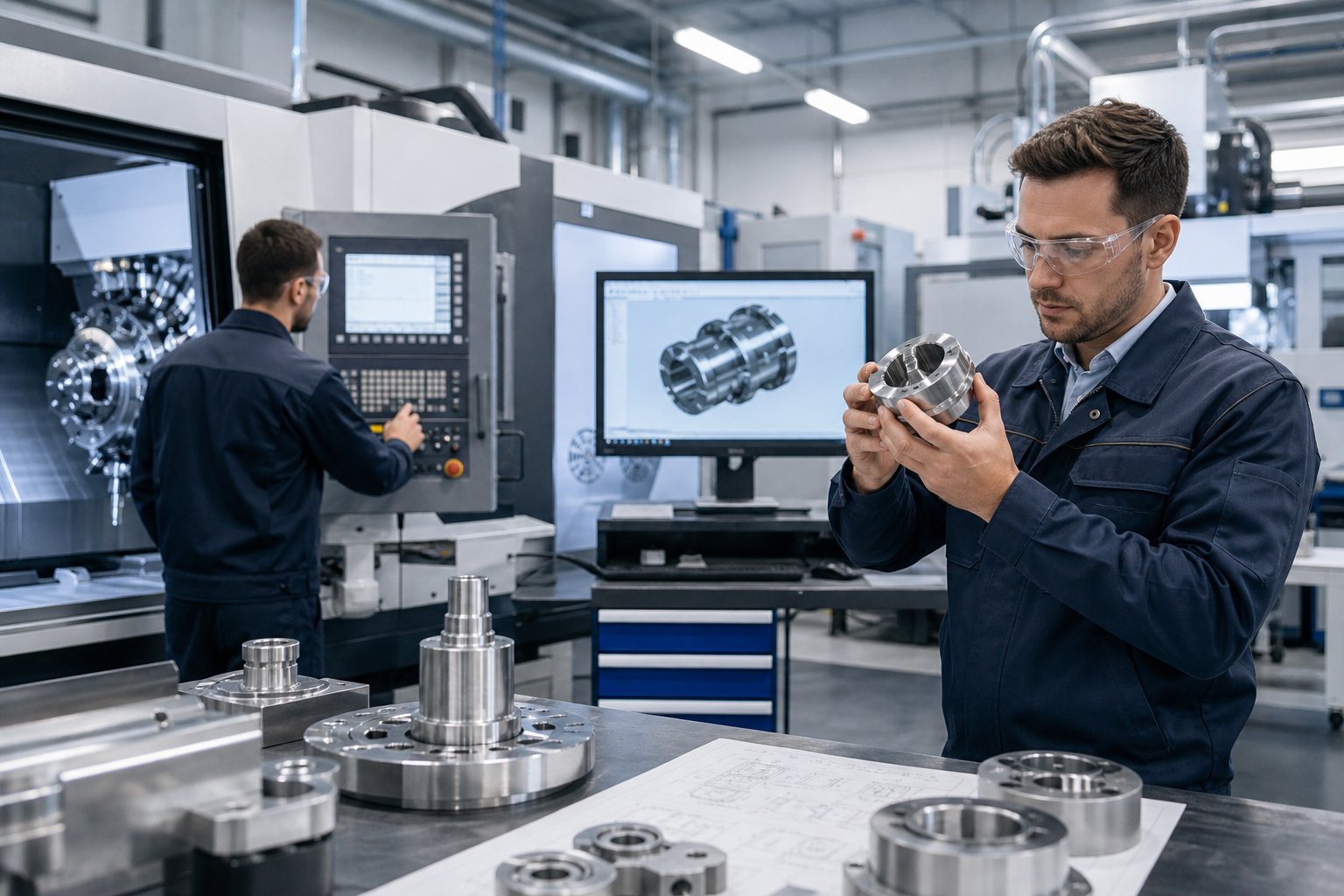
Custom manufacturing for industrial components lives and dies on machining precision, material integrity, and the ability to combine fabricating, welding, and finishing into a seamless production flow. Whether you need a single prototype or a repeatable production run of 500 sheaves, the manufacturing services you choose will determine the performance and longevity of every part.
Material Selection For Performance And Service Life
Choosing the right material is not a formality. It is one of the most consequential decisions in your project. A sheave machined from alloy steel behaves very differently under load than one made from aluminum or nylon. Your operating environment, load requirements, corrosion exposure, and wear expectations should all drive the material conversation.
Experienced manufacturers will guide you through these tradeoffs before production starts. Bear Equipment, for instance, machines custom sheaves from alloy steel, stainless steel, aluminum, nylon, and other specialty materials, matching each to the application’s demands. The goal is not to default to the most expensive option but to select the material that delivers the best service life for your specific use case.
Machining, Welding, And Fabricating Under One Roof
When your CNC machining, welding, and fabricating happen in separate facilities, you pay for transportation between each step, you lose time to scheduling conflicts, and you increase the risk of handling damage. Consolidating these processes in one shop eliminates those inefficiencies.
A manufacturer with in-house CNC capacity, welding stations, and assembly capabilities can sequence operations to minimize setup time and maintain dimensional accuracy throughout. Integrated production also simplifies quality checks because the same team controls every step from raw material to finished component.
From Prototype To Repeatable Production
Prototyping is where your design meets reality. A good manufacturer builds your first article, measures it against specifications, and identifies any refinements needed before committing to a full production run. This stage is where DFM feedback and engineering collaboration pay off most directly.
The transition from prototype to repeatable production should be seamless. Your tooling, fixturing, and process documentation from the prototype phase carry forward so that part number 100 matches part number 1. That consistency is what separates custom manufacturing from one-off job shop work.
Engineering Support That Improves The Final Part
The best engineering services do not just translate your sketch into a drawing. They actively improve your component’s performance, manufacturability, and cost-effectiveness. When engineering design is embedded in the manufacturing process, your product development cycle becomes faster and your final parts become better.
Application Review Before Production Starts
Before any material is cut, a thorough application review can prevent costly mismatches between your component and its operating environment. This means asking the right questions: What loads will the part see? What is the duty cycle? Is the environment corrosive, high-temperature, or subject to abrasive wear?
Manufacturers that take application review seriously, rather than simply quoting to a drawing, will catch issues you might not anticipate. For instance, specifying a plain bore when your shaft speed requires a sealed bearing could lead to premature failure. That upfront conversation, typically free of charge at manufacturers like Bear Equipment, protects you from expensive field problems down the road.
Design Refinements, Bore Options, And Post-Machining Choices
Small design refinements often produce outsized improvements in part performance. Adjusting a groove profile by a few thousandths, selecting the right bore configuration, or adding a post-machining treatment can extend service life significantly.
Consider bore options alone: plain bore, oilite bushings, grooved bushings, keyed bore, and various bearing types each serve different applications. Similarly, post-machining processes like flame hardening increase wear resistance in the rope groove, powder coating adds corrosion protection, and plating enhances surface durability. Your engineer should present these choices with clear tradeoffs so you can make informed decisions rather than defaulting to whatever is easiest to machine.
Replacement And Replication Of Existing Components
Sometimes you do not have a drawing at all. You have a worn-out sheave pulled from a crane, a winch drum that is no longer in production, or a block with no identifying markings. A capable manufacturing partner can reverse-engineer these components.
The process involves inspecting the existing part, measuring critical dimensions, identifying the original bore configuration, and creating production drawings from scratch. In some cases, the manufacturer may suggest design improvements based on how the original part failed. This capability is particularly valuable for maintaining legacy equipment where OEM replacements are unavailable or prohibitively expensive.
Quality Systems And Production Readiness
Quality is not a department. It is a discipline woven into every stage of production, from drawing approval through final inspection. Production readiness means your manufacturer has the systems, personnel, and capacity in place before the first part hits the machine.
Inspection, Drawing Control, And Process Discipline
Reliable quality starts with drawing control. Every revision must be tracked, approved, and distributed to the shop floor so that machinists are always working from the current version. Inspection checkpoints at key stages, after machining, after finishing, and after bore installation, ensure that deviations are caught early.
Process discipline means documenting how each operation is performed and verifying that it stays consistent across every production run. Production readiness reviews evaluate whether manufacturing processes and quality management systems provide low-risk assurance for ongoing production. This level of rigor may sound like it belongs only in aerospace or defense, but it applies equally to any industrial component where failure carries real consequences.
Certifications Buyers May See Across Manufacturing Categories
Different industries require different certifications. In electronics manufacturing, you may encounter standards like IPC J-STD-001 for soldering, IPC-A-610 for electronic assemblies, and IPC/WHMA-A-620 for cable and wire harness assemblies. Some manufacturers hold certifications as a certified woman-owned business, WOSB, or WBE, which can be relevant for government contracting or supplier diversity programs.
For precision-machined industrial components, the most important indicator of quality is often the manufacturer’s documented process discipline and track record rather than a specific certification number. Ask to see inspection reports, drawing control procedures, and evidence of consistent on-time delivery.
Capacity Planning, Stocking Programs, And Fast Turnaround
Lean manufacturing principles applied to custom work mean your manufacturer plans capacity proactively rather than reactively. Stocking programs, where a manufacturer maintains inventory of your most-used components, reduce lead times from weeks to days.
Fast turnaround depends on having raw materials on hand, CNC machines available, and a production schedule that accommodates both standard and rush orders. Same-day quoting, a practice that manufacturers like Bear Equipment emphasize, signals that the organization is structured for responsiveness. Fulfillment speed is not just about machining fast. It is about planning well.
How To Evaluate A Partner For Custom Industrial Work
Choosing a manufacturing partner is one of the highest-leverage decisions you will make on any industrial project. The wrong choice costs you in rework, missed deadlines, and components that do not perform. The right partner is not just a vendor but an extension of your engineering team.
Questions To Ask About Capabilities And Lead Times
Start with specifics. What is the maximum diameter they can machine? What materials do they stock versus source? How long does a typical first-article run take, and how does that change for repeat orders?
Ask about engineering support: do they offer DFM feedback, and is it included in the quote or billed separately? Understanding what makes a good contract manufacturing relationship means asking about their manufacturing services holistically, not just whether they own the right machines. Probe their change order process, too. A partner that can incorporate a design revision mid-run without resetting the entire schedule saves you real time and money.
When Electro-Mechanical Assemblies, Wire Harness, And Cables Matter
Not every custom manufacturing project involves machined metal. Some applications require electro-mechanical assemblies, wire harness fabrication, or custom cables integrated into a larger system. If your project spans these categories, evaluate whether your manufacturing partner handles them in-house or subcontracts them out.
Subcontracting is not inherently bad, but it adds communication layers and coordination risk. Companies like Custom Manufacturing & Engineering (CME) specialize in combining electrical engineering services with manufacturing under one roof, offering cable assemblies, wiring harnesses, and electronic box builds alongside engineering design. If your application requires this type of integration, confirm that your partner has both the capability and the quality controls to manage it.
What A Strong Manufacturing Relationship Looks Like
The best manufacturing partnerships are built on transparency, mutual respect, and aligned expectations. Your partner should give you honest lead times, flag potential problems early, and deliver consistent quality without requiring you to micromanage every order.
Look for responsiveness during the quoting process. How quickly do they return quotes? How detailed are those quotes? A manufacturer that provides same-day quotes with clear line items is signaling that they value your time and have their operations organized. Evaluating a manufacturing partner beyond their equipment list means assessing their communication habits, their willingness to invest in your project’s success, and their track record with customers who have similar needs.
Frequently Asked Questions
What types of projects are best suited for a custom-built solution versus an off-the-shelf product?
Custom-built solutions make sense when your application involves non-standard dimensions, unusual materials, specific load requirements, or integration with existing equipment that catalog parts cannot match. If an off-the-shelf component requires significant modification to work, you are often better off starting with a custom manufacturing approach that is designed for your exact specifications from the beginning.
How do I go from an idea or sketch to a manufacturable design?
Start by sharing your concept, even a rough sketch with key dimensions and performance requirements, with a manufacturer that offers engineering support. Their engineering team will review the application, ask clarifying questions, and develop production drawings. Many manufacturers, including Bear Equipment, provide this engineering at no extra charge for custom projects.
What information should I provide to get an accurate quote and timeline?
At minimum, provide part dimensions, material preferences, quantity needed, bore or mounting requirements, and any finishing specifications like coating or hardening. If you have existing drawings or CAD files, include those. The more detail you provide upfront, the more accurate your quote and timeline will be. Missing information is the most common cause of quote delays.
What materials and fabrication methods are commonly used for low- and mid-volume production?
For machined industrial components, common materials include alloy steel, stainless steel, aluminum, and engineering plastics like nylon. CNC machining, welding, and roll forming are typical fabrication methods. The choice depends on your part geometry, strength requirements, and operating environment. Low-volume runs often use the same CNC processes as high-volume production, just with shorter setup amortization.
How are prototypes tested and validated before moving into production?
Prototypes are typically inspected against the production drawing using precision measurement tools. Critical dimensions, bore fitment, surface finish, and any post-machining treatments are verified. In some cases, functional testing under simulated load conditions is performed. The prototype phase is your opportunity to confirm that the design performs as intended before committing to a full run.
What quality control and documentation standards are used during manufacturing?
Quality control typically includes inspection at multiple production stages: after machining, after finishing, and after bore or bearing installation. Drawing control ensures machinists always work from the latest approved revision. Documentation may include inspection reports, material certifications, and process records. The specific standards vary by industry, but consistent process discipline and traceability are the common denominators across reliable manufacturers.